
Haskell County Court Records After Arrest
The Haskell County arrest to court path runs through the sheriff, the prosecutor, and the Kansas district court system. Booking confirms that a person was taken into custody. A court record starts after the prosecutor files a criminal complaint or other charging paper in district court. That filed case is where the charge name, case number, bond order, hearing dates, warrants, dismissals, amendments, pleas, trial settings, and final disposition are tracked.
Haskell County is part of Kansas's 26th Judicial District with Grant, Morton, Seward, Stanton, and Stevens counties. The Haskell County District Court contact published by the Kansas Judicial Branch is phone (620) 675-2671, fax (620) 675-8599, Monday through Friday, 8 a.m. to 5 p.m. For custody or booking facts, use Haskell County jail inmate records. For booking photos, use Haskell County jail mugshots. Court records after a jail arrest should be checked through the court case system or the district court clerk.
The Kansas Judicial Branch 26th Judicial District page identifies the court district that includes Haskell County and gives the district court contact channel.
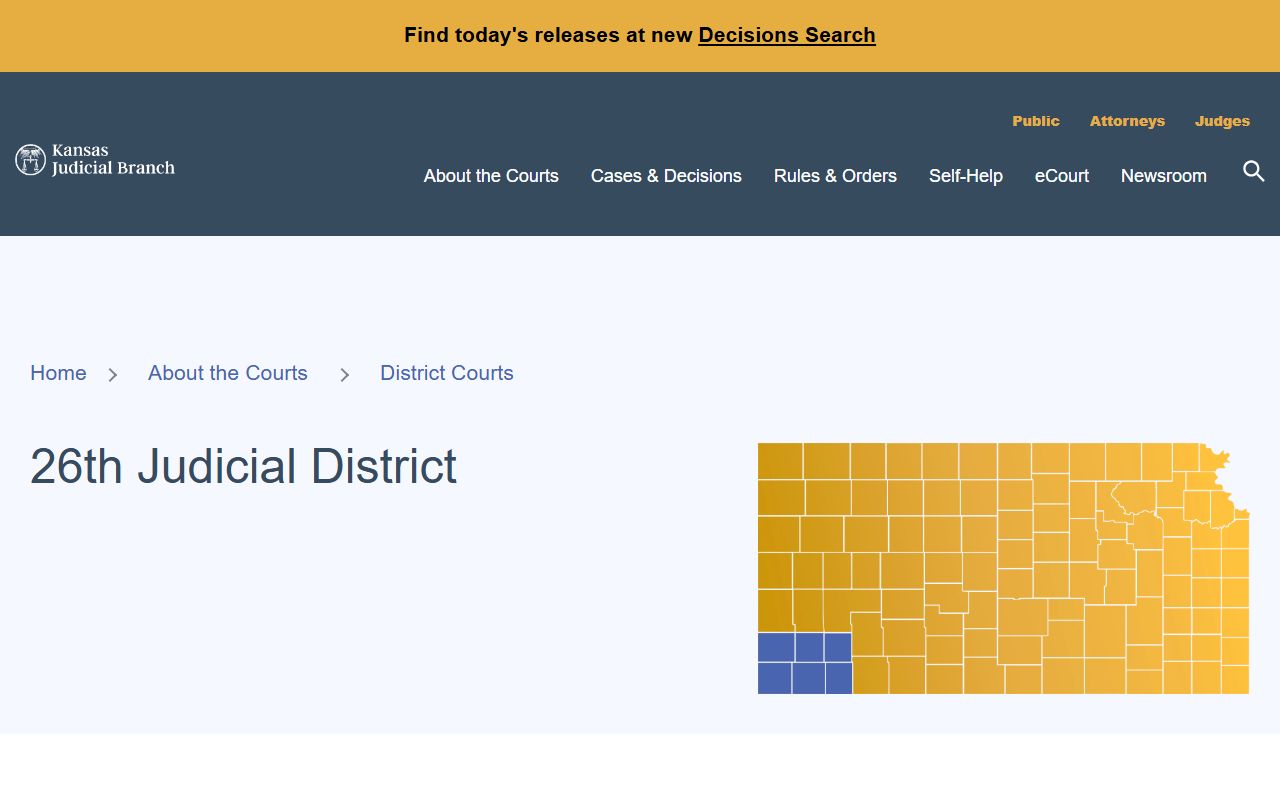
That district listing is the official court starting point when an online case search does not answer a Haskell County arrest question.
Search Haskell County Arrest Court Records
Kansas Case Search is the statewide public portal for filed district court cases. Direct inspection of the portal fields was blocked during research, so exact field labels should not be assumed. Use the portal for its public function: searching filed cases by party, name, case number, or other case information that the system makes available. If the person was just booked, the case may not appear until prosecutor review and filing have occurred.
- Start with the full legal name and, if known, the date of arrest or booking from the sheriff.
- Search Kansas Case Search for a filed Haskell County district court case after the prosecutor has had time to file.
- If no result appears, call the Haskell County District Court clerk with the name, approximate arrest date, and any booking or warrant detail.
- Compare the filed charges with the booking or arrest information. They can differ.
- For documents not visible online, older files, sealed files, or access questions, ask the clerk what is available for public inspection.
The older Kansas Judicial Branch district court records guidance explains that public district court records are made available through the online portal as courts use centralized case management. A missing online result is not proof that no arrest occurred or that no case will be filed. It can mean the case has not been filed yet, the name was searched in a different form, the record is restricted, or the document must be requested from the clerk.
The Kansas Case Search portal is the main statewide access point for Haskell County court records after a jail arrest once a district court case has been filed.
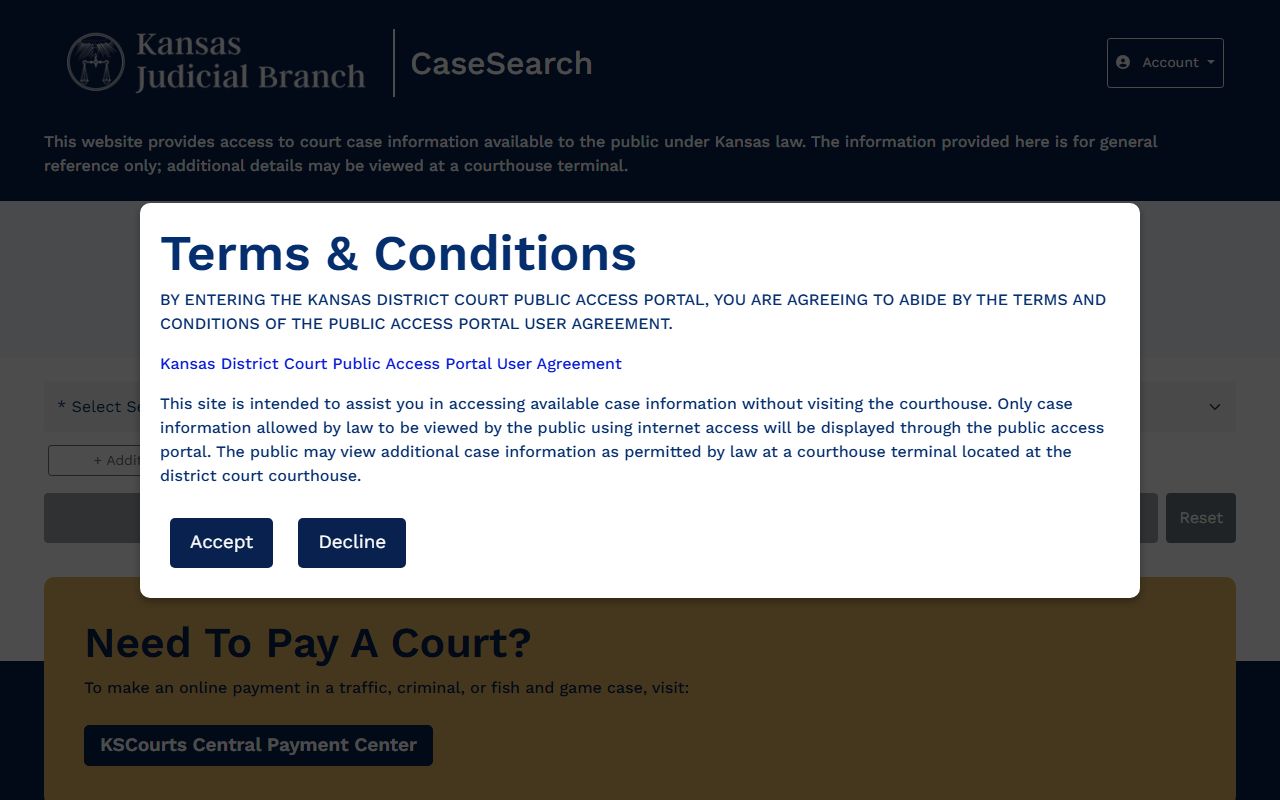
Use the portal for filed court records, then fall back to the Haskell County District Court clerk when a docket, document, or sealed-record question needs local handling.
Haskell County Charges After Arrest
The Haskell County prosecutor is typically the county attorney. A current official county attorney page was not verified in the research, so unverified contact information should not be treated as current. The role is still central. The county attorney reviews sheriff reports, witness information, probable-cause material, and any prior history before deciding what charges to file, decline, amend, reduce, or add.
That review is why a jail arrest record and a court record can look different. The arrest entry may reflect an officer's initial allegation, a warrant, a hold, or a broad charge description. The court file reflects what the prosecutor filed and what the judge acted on. In Haskell County court records after an arrest, the filed complaint or information carries more weight than a booking label when a reader wants the current legal status of a case.
| Charging Paper | Who Uses It | What It Does | Haskell County Context |
|---|---|---|---|
| Complaint | Prosecutor or law enforcement through prosecutor review | States the criminal accusation and can begin a district court case. | Common starting point for local misdemeanor and felony filings after a jail arrest. |
| Information | Prosecutor | Formal charging document used after preliminary steps in many felony matters. | May replace or refine earlier allegations once the case moves forward. |
| Indictment | Grand jury | Formal grand-jury charge. | Less common for routine local cases, but still a charging-document type in criminal procedure. |
Haskell County Charge Status
Charge status is the part of a Haskell County court record that tells whether a count is still pending, has changed, or has reached a result. Read each count separately. One charge may be dismissed while another remains pending. A warrant may be tied to a missed court date rather than a new arrest. A bond entry can show release terms without proving guilt.
| Status | Plain Meaning | What to Check |
|---|---|---|
| Pending | The charge has not reached final disposition. | Next hearing date, bond terms, counsel status, and any active warrant. |
| Amended | The prosecutor or court filing changed the charge wording, severity, or count. | Compare the original filing with the latest docket entry. |
| Dismissed | That count is not proceeding in the filed case. | Whether other counts remain and whether dismissal was with or without later refiling. |
| Diversion | A prosecutor-supervised alternative may resolve the matter if conditions are met. | Program terms, review date, and final disposition after completion or failure. |
| Conviction | Guilt was established by plea, verdict, or adjudication. | Sentence, probation, jail credit, fines, and appeal or post-judgment activity. |
| Warrant or FTA | A court order may exist after failure to appear or comply. | Call the court or sheriff before relying on old docket information. |
Disposition means the court result. It can include conviction, dismissal, acquittal, diversion outcome, or another final action. The status should be read with dates because a docket can show several events in a row.
Charges Versus Convictions
A Haskell County jail arrest is not the same as a conviction. An arrest is custody. A charge is an accusation filed in court. A conviction is a court result after a plea, verdict, or adjudication. This distinction matters for job, housing, licensing, bond, and record-clearing questions, because a person can be arrested and never convicted.
| Point of Comparison | Charge | Conviction |
|---|---|---|
| Legal stage | Accusation in a filed criminal case. | Final finding of guilt or accepted plea. |
| Proof level | Based on probable cause and prosecutor filing judgment. | Based on plea or proof beyond a reasonable doubt. |
| Can change | Can be amended, reduced, dismissed, or added. | Can be appealed or later affected by post-judgment orders. |
| Record impact | May appear in court records and criminal-history sources. | Usually carries sentence, probation, fine, jail, or prison consequences. |
Bond and Arrest Warrants
Kansas bond law is built around avoiding needless pretrial detention when detention is not needed for justice or public interest. In practical Haskell County terms, the first check is whether the person is still in jail, whether a bond has been set, and whether another hold blocks release. Call the Haskell County Sheriff's Office at (620) 675-2289 for custody and bond-status questions, then confirm filed case details with the district court clerk.
Common release terms include cash bond, surety bond through a licensed bonding company, personal recognizance release, appearance bond with conditions, property bond when a court allows it, and no-bond hold status. Holds can come from probation, parole, another county, a federal agency, immigration custody, or a new court order. Haskell County did not publish official payment methods, kiosk details, card fees, or a bond window in the sources found, so those details should be verified before anyone travels or sends funds.
No official Haskell County active-warrant search or most-wanted list was located. Warrant questions should go to the sheriff for arrest and custody facts and to the district court for bench-warrant and case context. A person should not rely on old third-party warrant pages or try to self-clear a warrant online. Speaking with an attorney, the issuing court, or the sheriff is the safer route.
Sealed and Expunged Records
Kansas public access rules affect what can be seen after a Haskell County arrest. The Kansas Open Records Act starts at K.S.A. 45-215, and K.S.A. 45-220 covers public-record request procedures. K.S.A. 45-221 includes exceptions for criminal investigation records and other protected information. Juvenile, medical, security, investigative, and sealed material may be limited even when part of the case is public.
| Record Treatment | What It Means | Haskell County Court Record Effect |
|---|---|---|
| Sealed | Public access is limited by court order or law. | The public docket or document may be hidden or partly blocked, while the court keeps the file. |
| Expunged | A qualifying arrest record may be restricted through the Kansas expungement process. | K.S.A. 22-2410 allows a petition for expungement of an arrest record under statutory conditions. |
| Redacted | Open parts are released while closed parts are removed. | Names, dates, or documents may be withheld when an exception applies. |
KBI Criminal History Records
Court records and criminal-history records are related, but they are not the same. A court docket shows a filed Haskell County district court case and its court events. A statewide criminal-history search is a separate Kansas Bureau of Investigation service. The KBI Kansas.gov criminal history record search costs $30, requires a KanAccess account, and is available from 4 a.m. to midnight Central.
The KBI service is not a free court docket and does not replace Kansas Case Search. It may be useful when a user needs a statewide criminal-history result rather than a single Haskell County court file. Consumer, employment, tenant, credit, insurance, and other regulated background uses have separate legal rules and should not be based on casual public-record browsing.
The Kansas criminal history record search page shows the KBI access route, fee, account requirement, and service window for statewide records.
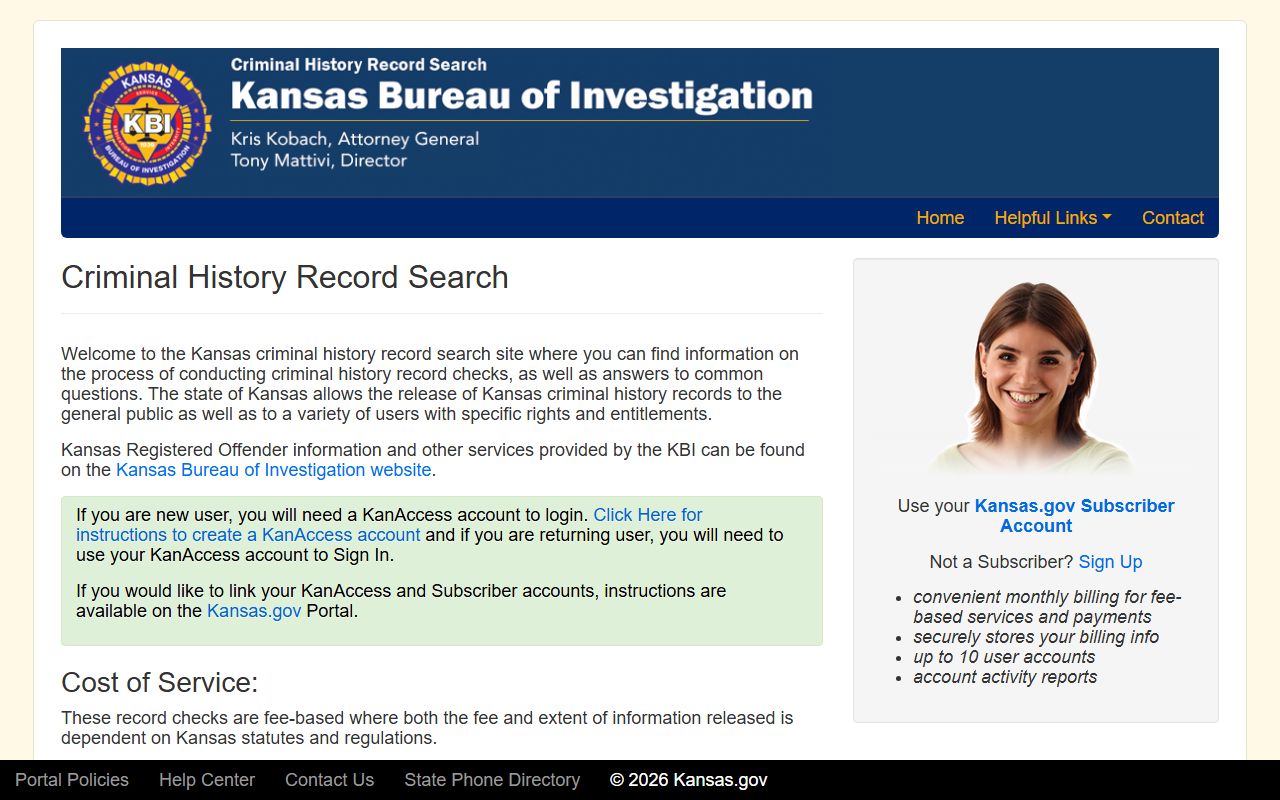
Use KBI criminal history when the need is statewide history, and use Kansas Case Search or the Haskell County District Court clerk for the filed court case itself.
Haskell County Court Search Fallbacks
When the court portal does not show a Haskell County arrest record, use a short fallback chain instead of guessing from unofficial sites. A missing online case can mean the case has not been filed, the name was searched in the wrong form, the record is restricted, or the person was released or transferred before filing appeared online.
- Confirm current custody, release, transfer, bond, and hold status with the Haskell County Sheriff's Office.
- Search Kansas Case Search again with alternate name forms after time has passed for prosecutor filing.
- Call the Haskell County District Court clerk with the name, approximate arrest date, and any booking or warrant detail.
- Submit a records request if the record sought is a public agency record that is not visible online.
If the person was sentenced to Kansas prison custody, court records remain with the court, but current custody may move to KDOC's KASPER system. If the issue is federal custody, use BOP or U.S. Marshals channels. If the issue is immigration detention, use ICE. These systems do not prove or disprove a Haskell County court case by themselves, but they can explain why a person is no longer in the county jail.
Important: Do not treat an arrest, charge, warrant, or online search result as a conviction unless the court record shows a conviction or final disposition.